6G Real-Time Ray Tracing Demonstration (Denver)
1:48
Description
Related Videos
Ray Tracing is a powerful technique for generating channel data deterministically.
View More
View Less
Related Videos
In Wireless
-
Play video AI-RAN Model Performance Testing Strategy
AI-RAN Model Performance Testing Strategy
VIAVI presents an AI-RAN model testing framework using neuromorphic receivers as a DUT. It evaluates communication, AI, and energy KPIs across the complete 3GPP parameter space — 20× faster than exhaustive testing.
7:20
-
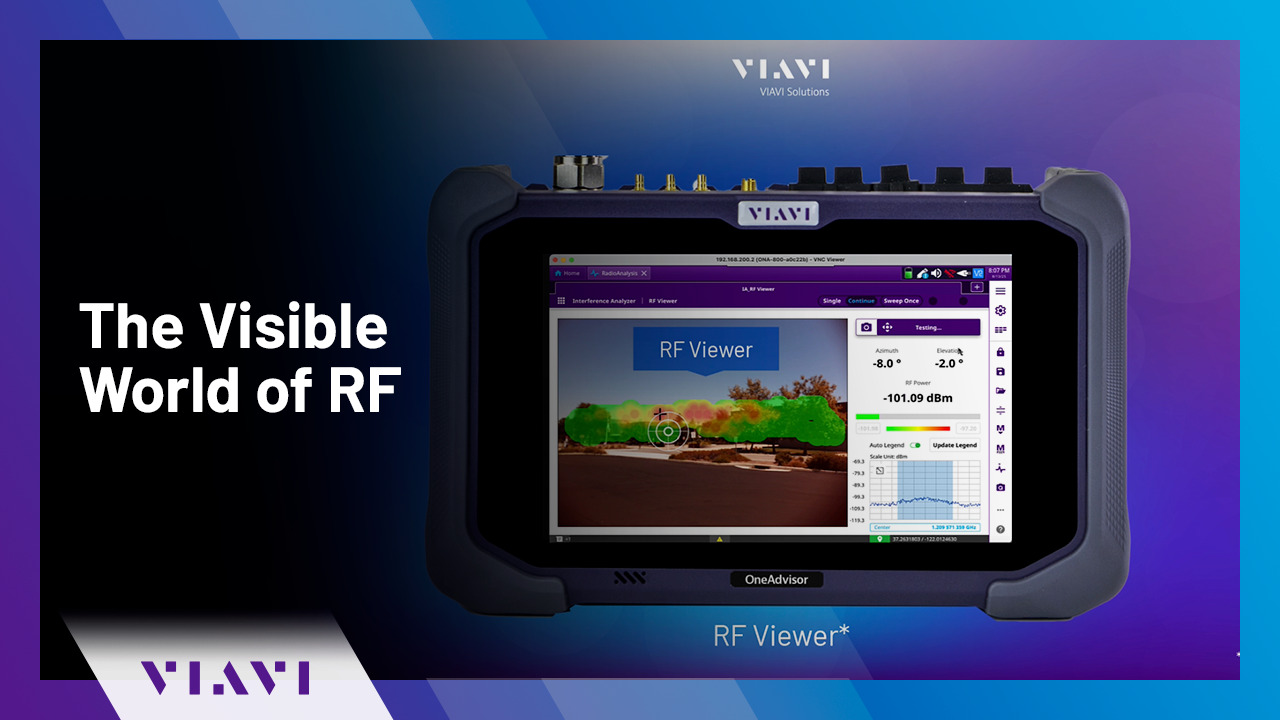
Play video The Visible World of RF
The Visible World of RF
The OneAdvisor 800 RF Viewer, an augmented reality (AR) solution, provides real-time visibility of RF signals in a physical environment.
2:55
-
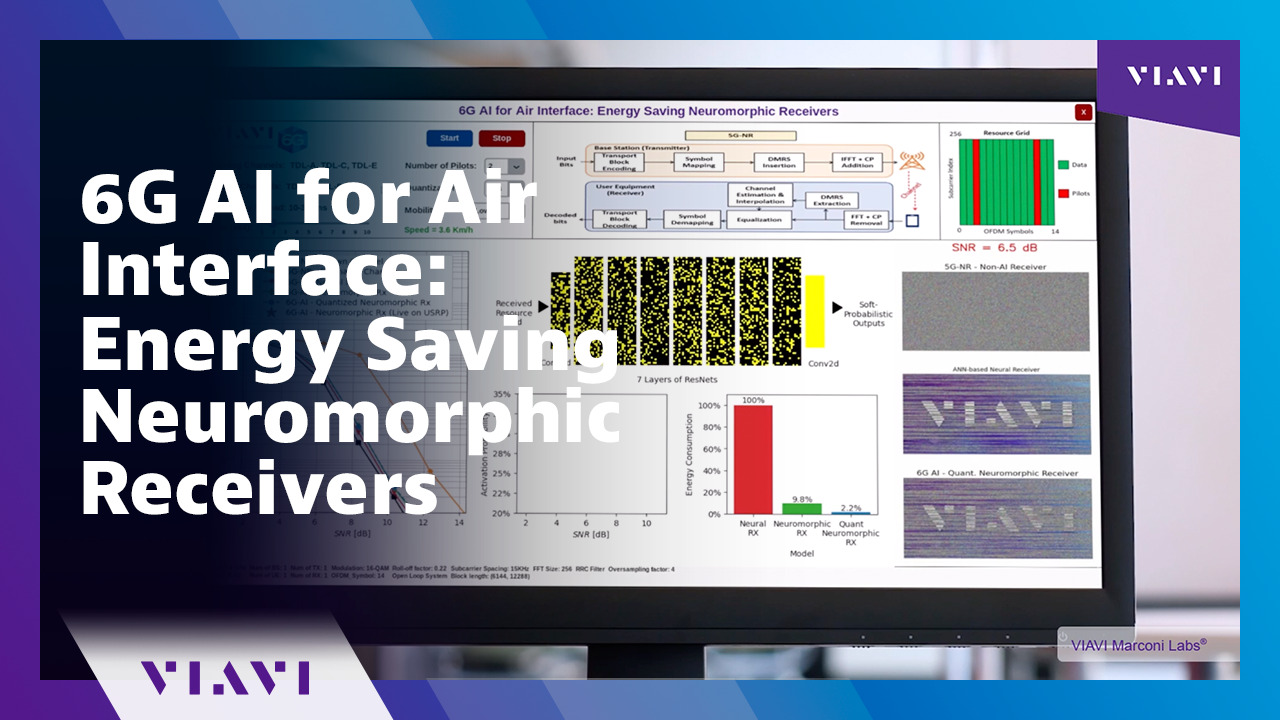
Play video 6G AI for Air Interface: Energy Saving Neuromorphic Receivers
6G AI for Air Interface: Energy Saving Neuromorphic Receivers
This demo shows that VIAVI has developed energy saving neuromorphic receiver.
2:41
-
Play video Agentic AI Raytracing with Inertial Labs Map Generator and PureAI-RT
Agentic AI Raytracing with Inertial Labs Map Generator and PureAI-RT
VIAVI's Agentic AI Ray Tracing platform combines a real-time RT engine with an AI assistant for intuitive channel simulation and radio planning. PureAI generates coverage heatmaps in milliseconds, outperforming low-resolution map baselines.
4:27
-
Play video Data Health Check - Safeguarding Your AI Models Through Every Stage - From Training to Production
Data Health Check - Safeguarding Your AI Models Through Every Stage - From Training to Production
VIAVI and AI-RAN Alliance present Data4AI: a data health check tool providing integrity, diversity, and similarity scoring for AI-RAN datasets — ensuring model quality from training through production deployment.
5:39
-
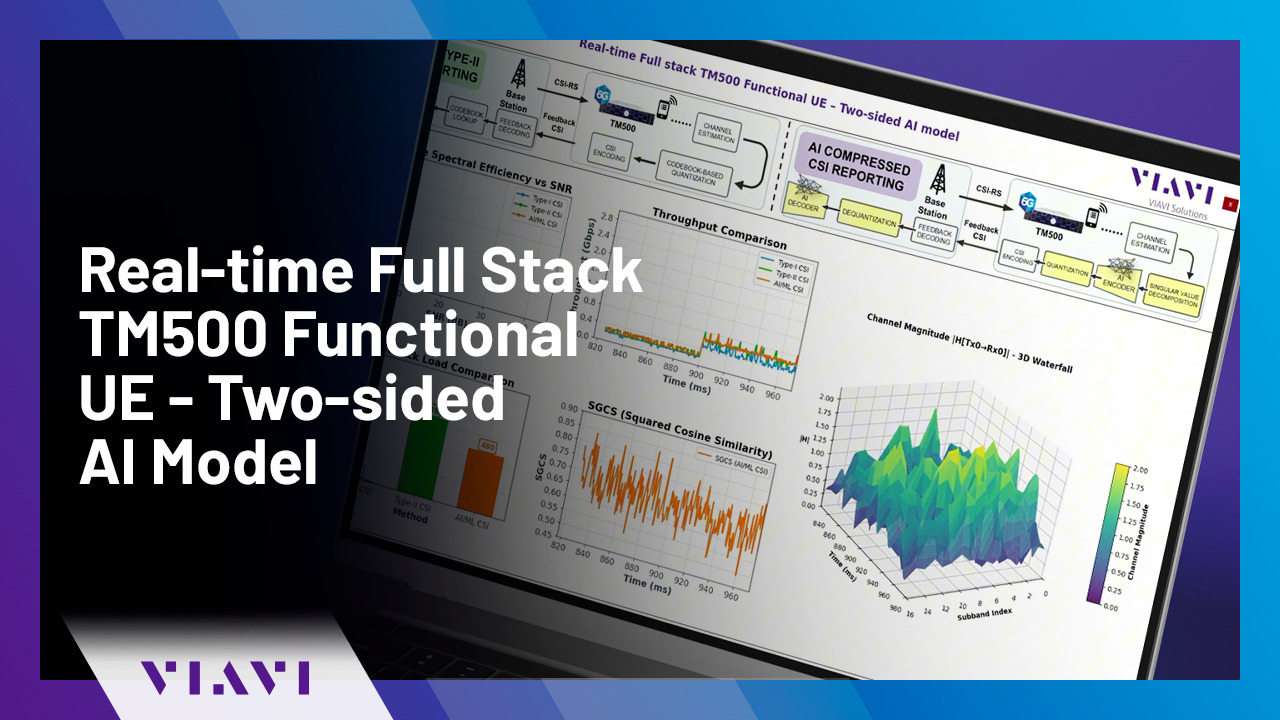
Play video Real-time Full Stack TM500 Functional UE - Two-sided AI Model
Real-time Full Stack TM500 Functional UE - Two-sided AI Model
VIAVI demonstrates AI/ML-based CSI compression on a real-time full-stack TM500 Functional UE. The AI encoder outperforms both Type-I and Type-II CSI reporting in spectral efficiency and throughput, with lower feedback overhead than Type-II.
2:24