How VIAVI Protects Data and IP
3:16
Description
Related Videos
Open RAN testing means sharing environments across vendors. VIAVI's Wilfred Luiz explains how VALOR's structured onboarding, physical controls and network segmentation protect each participant's confidential data and IP.
View More
View Less
Related Videos
In 5G Development
-
Play video Robot Marathon AI RSG on NVIDIA
Robot Marathon AI RSG on NVIDIA
Autonomous robots will share the same cellular infrastructure as consumer devices, creating new RF and capacity challenges. Robot marathons are just the start, but delivery fleets, drone corridors, even city-skyline drone shows are headed the same wa
0:19
-
Play video Why VIAVI Puts Real-World Data At The Center Of AI
Why VIAVI Puts Real-World Data At The Center Of AI
AI models are only as good as the data that trains them. VIAVI's Srinivas Sriram explains how VALOR's automation and 600+ real test cases are cutting integration time and building a stronger data foundation for Open RAN AI.
4:22
-
Play video TeraVM AI RSG - Train and Test rApps Without a Live Network
TeraVM AI RSG - Train and Test rApps Without a Live Network
VIAVI TeraVM AI RAN Scenario Generator gives you a practical environment to build, train and validate rApps without depending on live networks.
6:55
-
Play video AI Driven Tilt Optimization
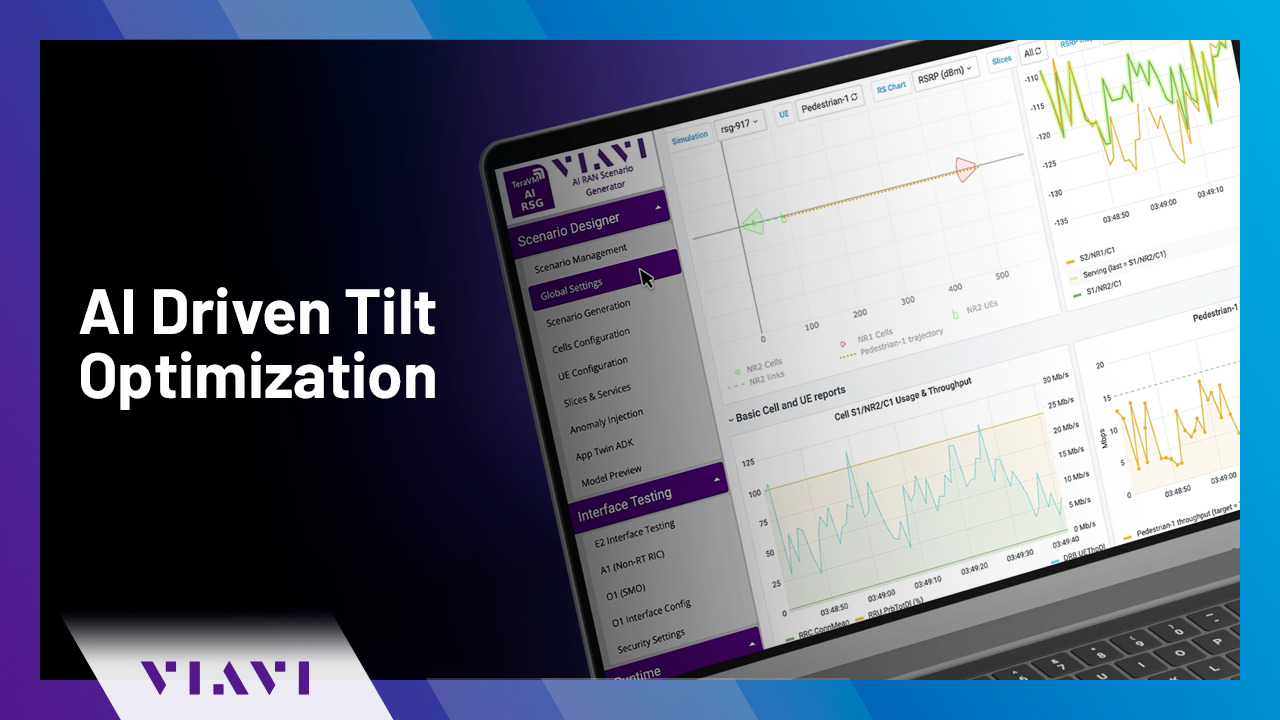
AI Driven Tilt Optimization
Antenna tilt has a big impact on a network. Too conservative and coverage holes appear, too aggressive and interference is caused. AI RSG allows tilt angles be experimented with comparing user QoS as the benchmark.
4:13
-
Play video How VIAVI Tests Next-Gen Networks
How VIAVI Tests Next-Gen Networks
Open RAN, AI-RAN, private 5G and satellite connectivity all depend on one thing: proof that technologies from different vendors can work together before they reach the network.
5:02
-
Play video From GSM-R to FRMCS: Committed to Every Railway Journey | VIAVI
From GSM-R to FRMCS: Committed to Every Railway Journey | VIAVI
Discover how VIAVI supports mission-critical railway communications, from optimizing today's GSM-R networks to enabling the transition to FRMCS through testing, monitoring, assurance, and cybersecurity.
6:19